TL;DR
Everyone has a coffee bit: the internal flag that says “sure, I’ll grab a coffee and hear what you’ve got”. People rarely leave because they hate the place. Things are fine, the bit flips, and nobody notices. A genuine “what’s up?” in every 1:1, continuous feedback and a visible ladder keep it at 0.
I once had an excellent senior IC. Brilliant.
At some point he went through a rough patch in his personal life. The company was extremely elastic about work-life balance: whatever he needed, he got. He was very loyal, and honestly, that elasticity was a big part of why.
I was his team leader, so we talked all the time. Continuous feedback, both flavors: what to improve, and loudly pointing out the good stuff. He was happy. I knew, because I kept asking.
Then I got promoted to group leader. Our every-other-week 1:1s turned into skip-levels, two or three a quarter. He also moved to another team, with my full support, and seemed genuinely happy there. Senior, trusted, thriving.
Before the next skip-level, he asked for a talk.
You know the talk. Every manager knows the talk.
He apologized (!). Friends from a previous company had opened a startup and offered him a role. He’d accepted.
Then he spent most of the meeting being super grateful. He’d had it good, he said. No frustration. Just a very tempting offer.
I was personally sorry to lose him, and genuinely happy for him career-wise. Both at once. Managing is weird like that.
Replaying it later, I can’t say more 1:1s would have kept him. It was a great offer from people he trusted. What I can say is that while we talked often, I knew what he was thinking. When the touchpoints dwindled, I lost that window. If a bit was quietly flipping from 0 to 1, I wasn’t around to see it.
I’d been going on about the coffee bit for years. Turns out it applies to skip-levels too.

Bit by Bit
Inside every person on your team there’s a single boolean:
| |
While it’s 0, recruiter pings get a polite “Thanks, but I’m happily employed”.
When it flips to 1, the same ping gets “sure, happy to chat”. And a coffee is never just a coffee.
The scary part? Nothing has to be wrong for the bit to flip. The team is fine. The product is fine. Everything is fine™. Just ask my former senior IC.
You Don’t Have to Hate a Job to Leave It
“People don’t leave companies, they leave managers.” You’ve heard it. It’s a classic for a reason.
The coffee bit adds a twist: often nobody did anything wrong. The 1:1 that used to happen just quietly stopped happening.
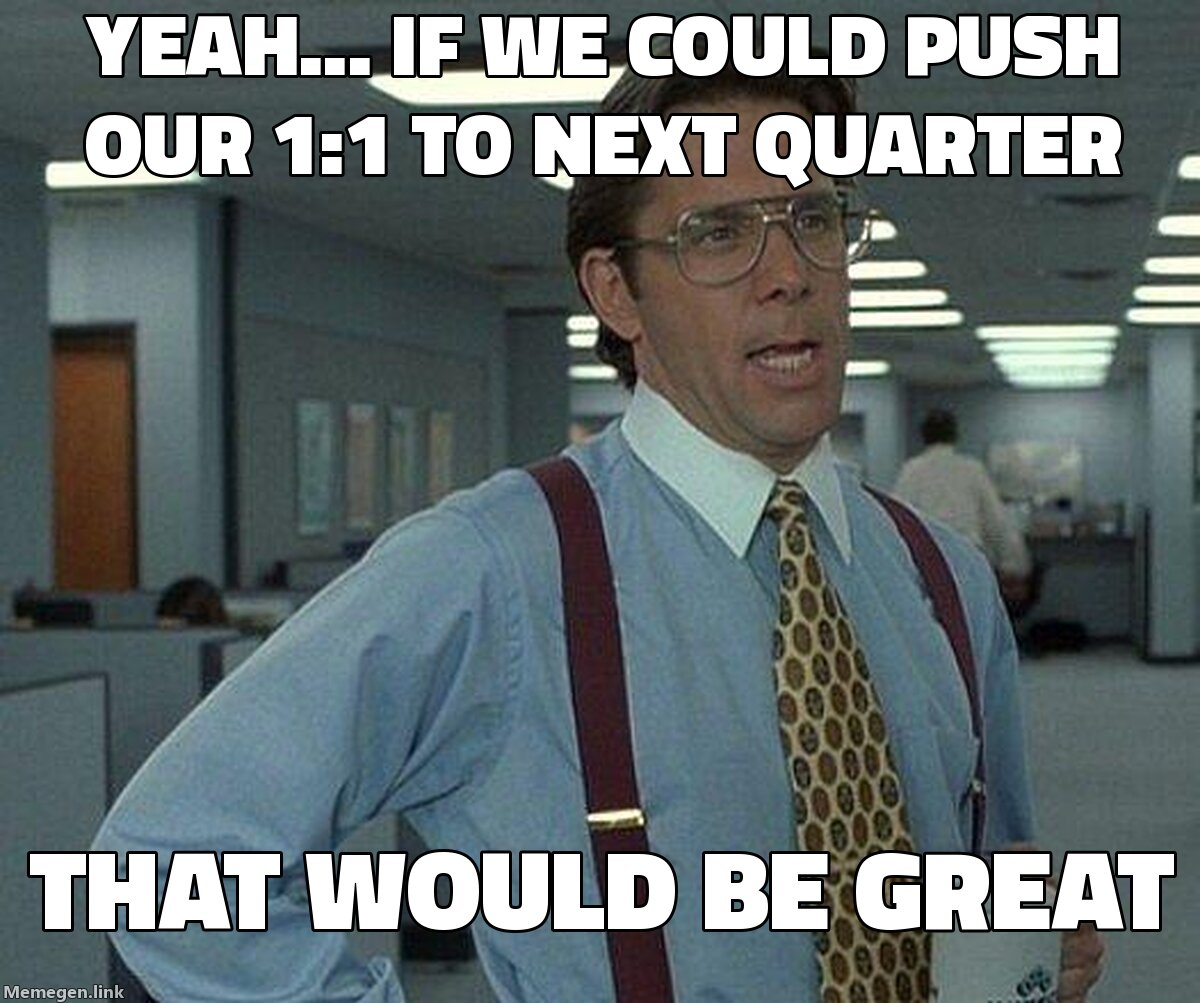
The coffee bit can flip in people who are doing great, too. It tends to flip when:
- They can’t picture what the next year looks like
- They haven’t heard “this was great, here’s what’s next” in months
- Their manager went from every other week to “see you next quarter”
None of these make anyone angry. They just make the coffee sound nice.
Signs of a Flipping Bit
You can’t read the boolean directly (no debugger for humans, yet). You can watch for side effects:
- The LinkedIn glow-up. New headline, new photo, suddenly “open to opportunities” adjacent.
- Short horizons. They stop volunteering for anything that ends after next quarter.
- Ladder questions, out of nowhere. “What does the next level actually mean here?” is a gift. Treat it like one.
None of these are proof. All of them are a reason to talk this week.
Keeping It at Zero
The fix isn’t a counter offer. By the time you’re countering, the bit has been 1 for months and the coffee was had.
The fix is boring, continuous and cheap. And it starts with two words.
1. Byte-sized 1:1s: start with “what’s up?”
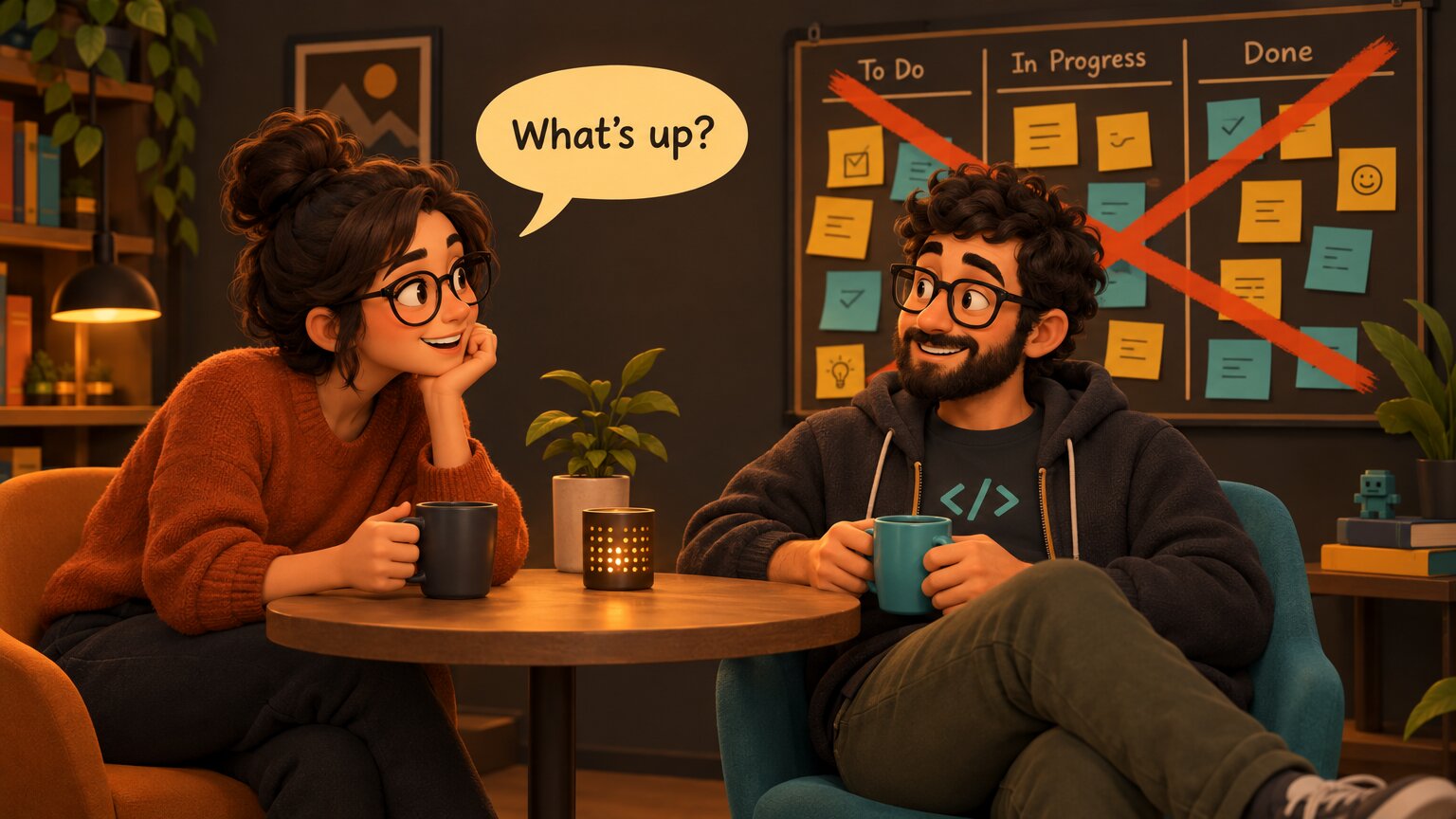
Every 1:1 starts the same way. Not with “what’s the status on the migration?” With “what’s up?”
And then you actually wait for the answer.
Task updates tell you about the work. The opener tells you about the human. A bit doesn’t flip in a Jira ticket, it flips in someone’s head, and the first place it leaks out is the answer to “how are you doing?”.
Some real-ish samples:
- “Fine.” Flat, fast, eyes already on the agenda. One “fine” is noise. Three in a row is a signal. Dig in: “Fine like good, or fine like fine?”
- “Honestly? A bit bored lately.” Jackpot. That’s not a complaint, that’s an early warning. Fixing boredom can take a while, but the conversation can start today.
- “Kid’s been sick, barely slept.” Not about work at all, and that’s the point. You now know why the PR is late, and they know you asked.
Skip the opener and you get an accurate status report from someone who might already be drafting a reply to a recruiter.
Everything else in this list builds on that trust.
2. Feedback that doesn’t wait for review season
If someone first hears “you’re doing great” in a formal review, that’s a bug. “You need to work on this”? Critical bug.
- Something specific, in every 1:1 (weekly, every other week, whatever cadence works for you both). Not “good job”, but “the way you broke down that migration made the review trivial”.
- Course corrections within days, not quarters.
- Asking for feedback back. “What should I do more of? Less of?” Awkward. Do it anyway.
3. A next step they can actually see
“Grow” is not a plan. Twice a year I run a PEP (Personal Evaluation Process). Yes, it sounds like a pep talk. No, it’s not a PIP.
It’s a long, honest sit-down, built around three things:
- An explicit next title. Not “senior-ish someday”, but a real title and subtitle for their logical next step, with a very verbose why. Even if that role doesn’t exist here yet.
- Feedback in both directions. They evaluate themselves, I add my take, and we write in bold what we agree on. Then they evaluate me. Awkward. Worth it.
- Explicit metrics for the coming quarter. Two quantifiable ones, like “lead two projects” or “influence three cross-team standards”, and one feel-based one, like “feels confident leading large meetings”.
Those metrics are the whole trick. “How are we doin’?” stops being a vibe and becomes a checklist you both look at. And it goes both ways: if they need to lead a project, finding them one is on me.
If they can see the next rung, and know exactly how far away it is, other ladders look a little less shiny.
4. Ask the coffee question yourself
Once the trust is there, my favorite 1:1 question: “If a recruiter pinged you today, would you take the call?”
I mean it as a health check, not a trap. But it only gets an honest answer if they trust you enough to give one, which is why it comes last. And a long pause isn’t a resignation letter. It’s your cue to stop talking and listen.
The Format
Every 1:1:
| Minutes | Topic |
|---|---|
| First 10 | “What’s up?” No tasks allowed |
| Next 10 | Feedback, both directions |
On top of that:
- Regularly: a quick look at the PEP metrics. How are we doin'?
- Twice a year: the full PEP
- Quarterly: “Would you take the coffee?”
The full format I use is in my manager README, along with the PEP process and its template.
Skip-levels count too. Mine even open with “Sup?”. Two or three a quarter means each “what’s up?” carries more weight, so never spend one on status. That’s exactly where I lost my window into my senior IC’s thinking.
The status updates go to Slack. The 1:1 is for the human. Human first, then bits.
When the Bit Flips Anyway
Sometimes it flips anyway. Friends with a startup, a dream role, a founder itch. That’s life.
My senior IC left with a thank-you speech, not a slammed door. That’s the good version of goodbye. The better version is hearing about the coffee before the offer. Maybe you fix something, maybe you help them leave well.
Brew Over Lessons
- Start every 1:1 with the human, not the tasks
- Continuous feedback beats annual surprises
- An explicit next step with real metrics keeps people looking forward
- Ask the coffee question, once they trust you enough to answer
The goal isn’t zero attrition. It’s zero surprises.
I’d tell you a joke about decaf, but it has no punchline. Just like a 1:1 without feedback.